





May 26, 2026
Associations are navigating a period of sustained disruption. Revenue models are shifting. Member expectations continue to evolve. External pressures related to policy, workforce and technology are accelerating the pace of change.
In this environment, association governance and board leadership are more important than ever. Boards help set direction, shape priorities and guide how organizations respond to change.
In our work with associations, we have seen that high-performing boards approach change in a structured way. A clear framework helps boards stay focused on the right questions, stay at the right level, avoid reactive decision-making and lead with greater confidence.
We use a five-step approach to support board-led change: frame what is changing, create a shared vision, activate exploration, decide with discipline and hold accountability.
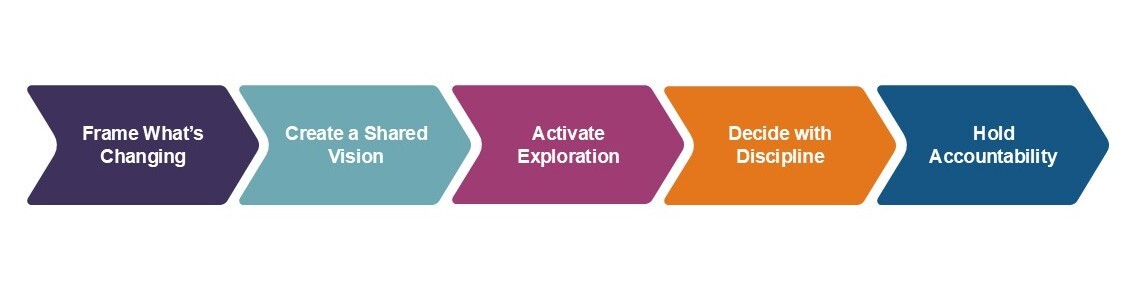
Frame What Is Changing
Strong association governance starts with context.
Effective boards step back from immediate challenges to understand the broader forces shaping their organization and the profession or industry it serves. This includes changes in technology, workforce dynamics, business models and member expectations.
At this stage, board leadership is focused on elevating the conversation. That means asking forward-looking questions:
- What is changing in our environment, and why does it matter?
- Where are we seeing early signals that our current strategy may not be sufficient?
- What risks do we face if we delay action?
Framing change in this way helps boards ground decisions in insight rather than urgency and strengthens their role as strategic leaders.
Create a Shared Vision
A core responsibility of board leadership is to define the purpose behind change.
A shared vision aligns stakeholders around what the organization is trying to achieve and why it matters.
Without that clarity, discussions often shift too quickly to tactics, which can create confusion or resistance.
Boards play a critical role in maintaining focus at the highest level. This includes:
- Clarifying the intended impact of the change
- Connecting the effort to organizational strategy
- Reinforcing the rationale for change across stakeholders
When association boards lead with purpose, they create alignment and build momentum that supports successful execution.
Activate Exploration
Effective association governance requires informed decision-making.
Boards are not responsible for designing solutions, but they are responsible for ensuring that decisions are grounded in strong insight. This includes directing staff or committees to assess issues, test assumptions and bring forward clear options.
At the same time, strong board leadership ensures that multiple perspectives are considered. This includes encouraging constructive challenge and making space for dissenting viewpoints.
Boards that prioritize rigorous exploration improve the quality of their decisions and reduce the risk of blind spots.
Decide with Discipline
Board leadership ultimately requires making decisions.
In a complex environment, not all uncertainty can be resolved. Boards must exercise informed judgment, understand risk and select a clear path forward. They must make decisions based on data and vision, not emotion. While change may not make everyone happy, the board’s goal is to ensure that the association thrives in the long term.
Deciding with discipline also means supporting the decision once it is made. This includes reinforcing the rationale, aligning communication and avoiding the tendency to revisit decisions without a clear trigger.
At the same time, effective boards remain adaptable. They adjust as new information emerges while staying anchored to the original purpose.
Hold Accountability
Accountability is a defining element of strong association governance.
Boards are responsible for ensuring that change delivers results. This does not involve managing day-to-day execution. It involves setting expectations and monitoring progress against strategic goals.
Effective boards:
- Define success at the outset
- Establish clear reporting expectations and measurable outcomes
- Focus on outcomes rather than activities
Accountability should be viewed as an ongoing process. Change is rarely linear. Boards that approach this as a continuous learning cycle are better positioned to adapt and sustain progress.
Strengthening Board Leadership for What Comes Next
Association boards are being asked to lead through increasing complexity. That requires clarity, discipline and a consistent approach to governance.
A structured framework helps boards focus on what matters most. It strengthens decision-making, improves alignment and reinforces the board’s role as a strategic leader.
When association governance and board leadership are aligned around a clear approach to change, organizations are better positioned to adapt and succeed in a rapidly evolving environment.
Learn More
A healthy, well-functioning board is key to an association’s success. Our team helps build highly effective boards that are ready to tackle an organization’s biggest challenges. Learn more here.
One of our signature governance training programs is our Next-Level Governance™: On-Demand Training, which equips boards with data-informed online lessons designed to strengthen change management, decision-making and effectiveness.


Business Models
8 min read
| September 30, 2026
How to Evaluate Your Association’s Offerings with a Portfolio Analysis
Read More
featured
9 min read
| August 27, 2026
How to Collaborate: Aligning Foundation and Association Strategic Plans
Read More
Strategic Planning
14 min read
| June 24, 2026